The conversation about biometric KYC usually starts in engineering or compliance and gets stuck there. The business case — clear, quantified, and tied to P&L line items — rarely gets built with the same rigour. That's a mistake. The ROI case for modern face verification is strong, and CFOs and business unit leaders who see it tend to accelerate investment rather than scrutinise it.
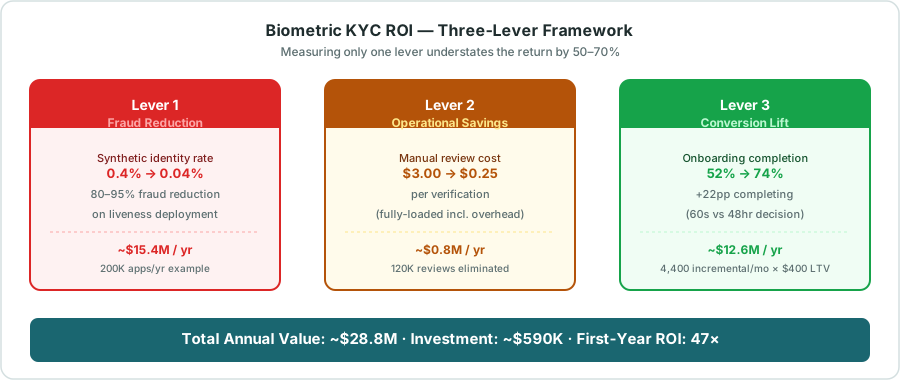
The three ROI levers
Biometric KYC delivers value through three mechanisms that need to be quantified separately and added:
- Fraud loss reduction — catching identity fraud and synthetic identities before they generate losses
- Operational cost reduction — replacing manual review headcount with automated decisioning
- Conversion lift — reducing onboarding abandonment by making verification faster
Most organisations only measure one or two of these. Measuring all three typically doubles the ROI figure and shifts the conversation from "cost reduction" to "strategic investment."
Lever 1: fraud loss reduction
Synthetic identity fraud is the fastest-growing category and the one where biometric liveness provides the clearest advantage. The synthetic identity doesn't have a living person to match a live face against — the liveness check alone fails the application. Industry benchmarks for financial services:
- Current synthetic identity rate on digital onboarding: 0.15–0.8% of applications
- Average loss per synthetic identity account (including balance, fees, recovery): $15,000–$45,000
- Expected rate after biometric liveness deployment: 0.02–0.1% (80–95% reduction)
Example: a mid-sized fintech processing 200,000 applications/year at a 0.4% synthetic fraud rate incurs roughly $17.6M in annual losses. After biometric liveness deployment, that drops to $2.2M — $15.4M in annual savings. A critical input often underestimated: your current fraud loss figures almost certainly undercount the true synthetic identity problem, since synthetic identities season accounts for 12–18 months before busting out.
Lever 2: operational cost reduction
The direct cost of manual review is lower than most teams expect — but the fully-loaded cost is significantly higher. A realistic per-review cost including indirect costs (queue latency, inconsistent outcomes, complaint handling, management overhead, tooling) is $2.50–$5.00, not the $1.00 often quoted for direct labour alone.
At $0.25/call for a face verification API at enterprise volume, 120,000 reviews (60% manual rate on 200,000 applications) becomes a $30,000/year API spend rather than $300,000–$600,000 in manual review costs. Beyond the review queue: "Where's my verification?" support tickets largely disappear with 60-second automated processing; periodic re-KYC for existing customers becomes a fully automated background process.
Lever 3: conversion lift
This lever is frequently omitted and is often the largest single contributor to ROI. The comparison isn't "face verification vs. nothing" — it's "60-second automated face verification vs. 48-hour manual review queue." The data:
- Completion rate with manual review (24–48 hour delay): 52%
- Completion rate with automated verification (<60 second decision): 74%
- Delta: 22 percentage points of incremental completions
For a product with 20,000 monthly application starts and $400 LTV per customer, 4,400 incremental monthly completions × $400 = $1.76M/month incremental revenue, or $21.1M/year. Even at conservative LTV figures, the conversion lift from removing friction often exceeds fraud savings and operational savings combined. This is the number that makes CFOs sit up.
Full ROI model
Combining all three levers for a 200,000 application/year mid-market fintech:
- Fraud savings: $15.4M
- Operational cost reduction: $0.8M
- Conversion lift (22pp improvement): $12.6M
- Total annual value: $28.8M
Against an investment of ~$590K/year (API costs at volume, integration amortised, compliance and monitoring), this is a 47× first-year return. These are mid-range industry assumptions — the actual numbers depend on your volume, LTV, current fraud rate, and operational structure.
Addressing common objections
"Our fraud rate is too low to justify this." Low measured fraud rate is often low detected fraud rate. Synthetic identity fraud by definition evades most detection systems — the identity looks clean. The real question is what a portfolio audit would find.
"We'll lose customers with face verification friction." The friction comparison is usually framed incorrectly. 60-second automated face verification has dramatically less friction than a 48-hour manual review queue.
"Our customers won't consent to biometric data collection." Consent rates for face verification in financial services contexts, when the consent flow is well-designed, are consistently above 92% in industry studies.
"The implementation is too expensive." The largest source of implementation risk is building custom biometric systems. A well-supported API reduces implementation to weeks, not quarters, and transfers model risk to a specialist provider.
Timing the investment
The ROI case strengthens dramatically as volume scales. The threshold where it becomes financially obvious is typically 5,000–10,000 verifications per month. If you're below that today but growing, the right time to integrate is before fraud and operations costs start scaling with volume — not after. Talk to our team to get a customised ROI model based on your actual volume and industry.