Enterprise Identity and Access Management is undergoing its most significant architectural shift since the move from LDAP to cloud SSO. Face recognition has matured from a novelty into a production-grade authentication factor with better security properties than TOTP, push notifications, and hardware tokens in specific threat models. This guide is for identity architects and engineering leads who need to understand where face recognition fits, how to wire it in, and what can go wrong.
NIST AAL alignment
NIST SP 800-63B (3rd revision, 2017) defines three Authenticator Assurance Levels. NIST SP 800-63-4 is in public draft and expected to finalise in 2025–2026 — check NIST's website for the latest revision before finalising your compliance documentation. The core AAL principles for biometrics are stable across revisions. Face recognition alone — without hardware binding — does not meet AAL3. With a hardware-bound capture device and cryptographic binding, it can reach AAL3. For most enterprise IAM use cases, AAL2 is the target level, and face recognition serves as the inherence factor (something you are) in a multi-factor scheme. NIST 800-63B explicitly recognises biometric characteristics as a valid authenticator type but notes they must be used in combination with a physical authenticator — the device that captures the biometric — rather than standalone.
Core architecture: the three-tier biometric authentication model
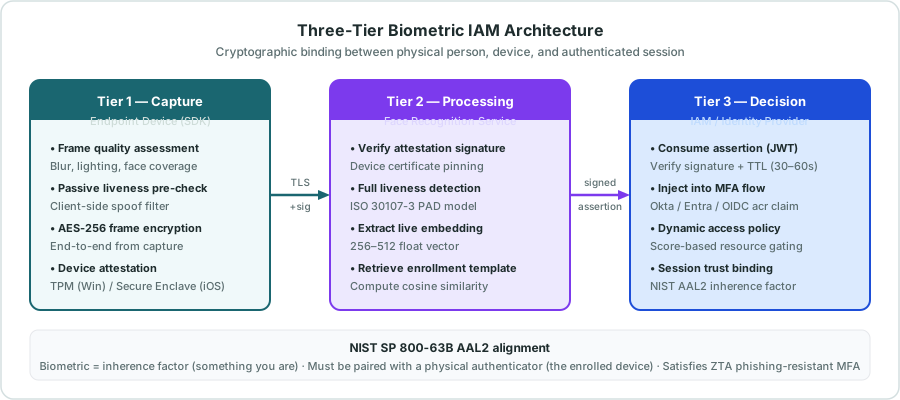
Production face recognition for IAM follows a three-tier architecture:
- Tier 1 — Capture: SDK on endpoint device (laptop camera, mobile, kiosk). Responsibilities: frame quality assessment, passive liveness pre-check, AES-256 frame encryption, device attestation via TPM (Windows) or Secure Enclave (macOS/iOS)
- Tier 2 — Processing: Face recognition service (cloud or on-premise). Verifies device attestation signature, runs full liveness detection, extracts live embedding, retrieves enrollment template, computes similarity, returns a structured assertion with short TTL (30–60 seconds)
- Tier 3 — Decision: IAM/IDP consumes the assertion as a second factor. The assertion includes: subject ID, match score, liveness result, device attestation status, assertion ID for audit binding, expiry timestamp
Zero Trust alignment
NIST SP 800-207 defines Zero Trust as continuous verification of identity and device posture. Face recognition maps cleanly onto several ZTA pillars:
- Identity pillar — face recognition provides strong cryptographic binding between the physical person and the authenticated session; combined with device attestation it satisfies ZTA's phishing-resistant MFA requirement
- Device pillar — the device-bound capture (Secure Enclave/TPM) creates a hard dependency between authentication and the specific enrolled device; stolen credentials cannot be used from an unenrolled device
- Continuous verification — periodic re-verification triggered for high-risk actions becomes feasible because face recognition's low friction works where password re-entry would not
- Session trust — the biometric assertion score can inform dynamic access policy; high-confidence match from attested device on managed network grants full access; lower-confidence match from unmanaged network triggers step-up
IDP integration patterns
Okta / Entra ID: implement as a custom MFA factor using the provider's extensibility APIs. The IDP calls your factor service during the auth flow, your service drives biometric capture, and returns the assertion to the IDP for inclusion in the session token.
SAML / OIDC IdP: include the biometric assertion as an authentication context class (acr claim in OIDC). Downstream relying parties can require specific ACR values for access to sensitive resources.
RADIUS / legacy: a biometric gateway accepts Radius auth requests, performs the biometric challenge, and proxies to the upstream Radius server only on success.
Enrollment architecture
Enrollment quality determines authentication accuracy. Capture 3–5 frames across slight variations in pose and lighting during enrollment; the stored template represents the average of multiple embeddings. Templates must be: encrypted at rest with keys separate from application keys; logically isolated per user — no cross-user template queries; versioned to support model updates; deletable on demand for GDPR/BIPA compliance.
Template updates on successful authentication (moving average) improve robustness against gradual appearance change but must be protected against injection: limit updates to high-confidence sessions (score > 0.9) from attested devices only.
The model update migration problem
Face recognition models improve, and new model versions produce embeddings that are not directly comparable to old-model embeddings — you cannot compute similarity between a live embedding from Model v2 and a stored template from Model v1. Strategies:
- Dual enrollment — at upgrade time, re-run all stored templates through the new model to produce new-model embeddings; run both models in parallel during a transition window, then deprecate
- On-demand migration — migrate the template on each successful authentication under the old model; after a window, force re-enrollment for users who haven't migrated
- Vendor-managed compatibility — some vendors maintain cross-model compatibility layers; verify guarantees and performance impact before relying on this
Model update migration needs to be in your integration plan before the first deployment — retrofitting under time pressure is painful.
Security threat model
- Stolen credential + synthetic face → liveness detection, device attestation
- Photo/video spoofing at kiosk → ISO 30107-3 PAD-compliant liveness model
- Frame injection attack (virtual camera) → cryptographic capture binding, device attestation
- Enrollment template theft → template encryption, isolation, access logging
- Replay of valid assertion → short-lived assertions (30s TTL), nonce binding
- MitM between capture and service → TLS mutual auth, device certificate pinning
If you're designing or reviewing an enterprise IAM integration, reach out to our team — we work through these patterns daily.