Identity verification has never been more consequential. Global losses from synthetic identity fraud exceeded $4.8 billion in 2025, and regulators in the EU, UK, and US are tightening KYC requirements at a pace that legacy processes cannot absorb. This guide gives enterprise architects and product teams a grounded comparison so you can make the right call for your organisation.
What "traditional KYC" actually means
Most enterprise KYC stacks combine three approaches: human agents inspecting ID scans and comparing selfies, rules-based OCR that extracts document fields and flags anomalies, and third-party bureau checks matching identity data against credit and watchlist databases. They work — until they don't. The failure modes are predictable: slow throughput at peak, inconsistent reviewer accuracy, and a document model designed for branch banking rather than 200-millisecond API calls.
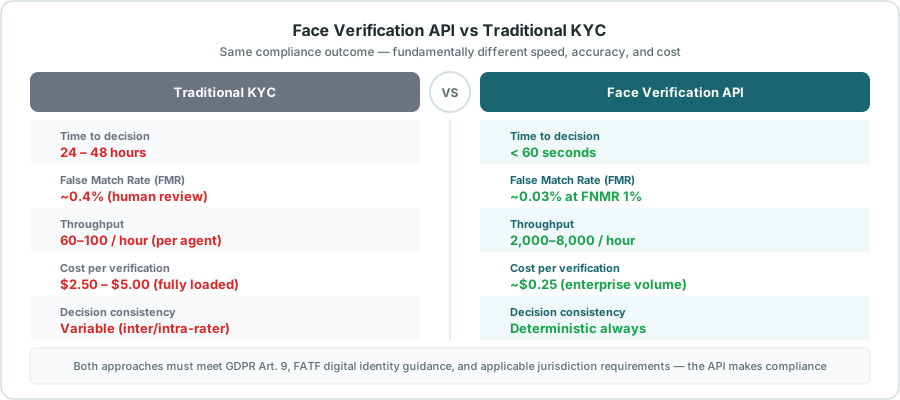
How a face verification API works
A modern face verification API replaces the selfie-comparison step with a trained computer vision model that: detects and localises a face in the submitted image or video frame; extracts a high-dimensional feature embedding (typically 256–512 floats); computes cosine similarity against the reference face extracted from the ID document; and returns a match score and liveness verdict in a single round-trip. The model never stores the raw image — only the transient embedding used for comparison. This distinction matters enormously for GDPR Article 9 and CCPA biometric data categories.
Accuracy: where modern models pull ahead
The benchmark that matters for enterprise is False Match Rate (FMR) at a given False Non-Match Rate (FNMR). A rule-of-thumb threshold for financial-services KYC is FMR ≤ 0.1% at FNMR ≤ 1%.
- Trained human reviewer — FMR ~0.4% @ FNMR 1%, throughput 60–100/hour per agent
- Rules-based OCR + photo compare — FMR ~1.8%, throughput ~800/hour per server
- Modern face verification API — FMR ~0.03%, throughput 2,000–8,000/hour per endpoint
Human reviewers introduce intra-rater and inter-rater variance — the same reviewer may reach different conclusions on the same image at different times of day. Models are deterministic: same input, same score, always.
One subtlety worth flagging: models trained on biased datasets can exhibit higher FMR for specific demographic groups. Rigorous vendors publish disaggregated benchmark reports across age, gender, and Fitzpatrick skin-tone scale. Request these before signing. If a vendor won't share them, that is a red flag.
Compliance: what changes and what doesn't
Moving to an API doesn't change your compliance obligations — it changes how easily you can meet them. GDPR Article 9 requires a legal basis and DPIA before large-scale biometric processing. FATF's 2023 guidance explicitly permits non-face-to-face onboarding when technology provides equivalent assurance — face verification with liveness detection qualifies, enabling fully digital KYC for use cases that previously required branch visits. The key practical improvement: deterministic, auditable API decisions are dramatically easier to defend to a regulator than a statistical sample of a reviewer queue that varies by shift.
Integration overhead
Traditional KYC integrations are often deep and brittle, touching document capture SDKs, OCR pipelines, manual review portals, and case management databases. A strategic advantage of face verification APIs is that they can be layered in incrementally — swap the biometric comparison step first, then automate document parsing, then deprecate the manual queue as confidence grows. A minimal backend integration typically takes under a sprint:
const result = await fetch("https://api.quantilence.com/v1/verify/face", {
  method: "POST",
  headers: { Authorization: `Bearer ${apiKey}`, "Content-Type": "application/json" },
  body: JSON.stringify({
    reference_image: idDocumentFaceBase64,
    probe_image: selfieBase64,
    liveness_check: true,
  }),
});
const { match_score, liveness, decision } = await result.json();
Total cost of ownership
The TCO comparison surprises most teams because the obvious costs (API call fees) are small relative to the hidden costs of legacy systems. At enterprise volume, reviewer headcount drops from 8–15 FTEs per 10,000 verifications/day to 0–1 FTE handling escalations only. Time-to-onboard drops from 1–3 days to under 60 seconds. Fraud losses from synthetic identity attacks drop by 80–95% once liveness is in place. Organisations that removed verification friction from days to minutes report 30–50% improvement in funnel conversion at the verification step alone.
Document verification — the step the API doesn't replace alone
A face verification API confirms that the selfie matches the ID document photo — it does not independently verify that the document is genuine. Full KYC requires document authenticity checks (MRZ validation, NFC chip reading, security feature inspection, watchlist screening) layered with the face match and liveness. Most enterprise deployments combine the face API with a document verification provider: the face API handles the biometric comparison with far higher accuracy than any generic OCR pipeline, while the document provider handles chip and security feature validation. Both layers are necessary; neither is sufficient alone.
When to keep human review in the loop
Automation shouldn't mean zero human judgment. Best-practice enterprise deployments use a tiered decisioning model:
- Auto-approve (score ≥ 0.85, liveness pass) — straight-through processing
- Refer-to-review (score 0.65–0.85 or liveness inconclusive) — agent reviews flagged cases
- Auto-reject (score < 0.65 or liveness fail) — document reason, give customer a recourse path
The review queue in this model typically handles 3–8% of volume, down from 100% in a fully manual operation. Reviewers focus on genuine edge cases rather than high-confidence decisions that don't need human judgment.
Questions to ask any vendor
- Will you share disaggregated FMR/FNMR across demographic groups under independent testing conditions?
- Where are inference servers located — can you pin processing to a specific region for GDPR or data sovereignty requirements?
- What attack vectors is your liveness detection evaluated against? (Print, replay video, 3D mask, deepfake)
- What is the P99 latency and the SLA for the verification endpoint?
- Does the API produce per-request audit logs with timestamps, scores, and decision rationale?
- How are model updates communicated, and is there a freeze period before breaking changes roll out?
If you're at the migration planning stage, talk to our team — we work through these integration questions daily.