Identity Verification in 2026: Five Trends Shaping the Year Ahead
How generative AI, tightening biometric regulation, and event-driven architectures are reshaping identity verification, fraud prevention, and document processing in 2026.
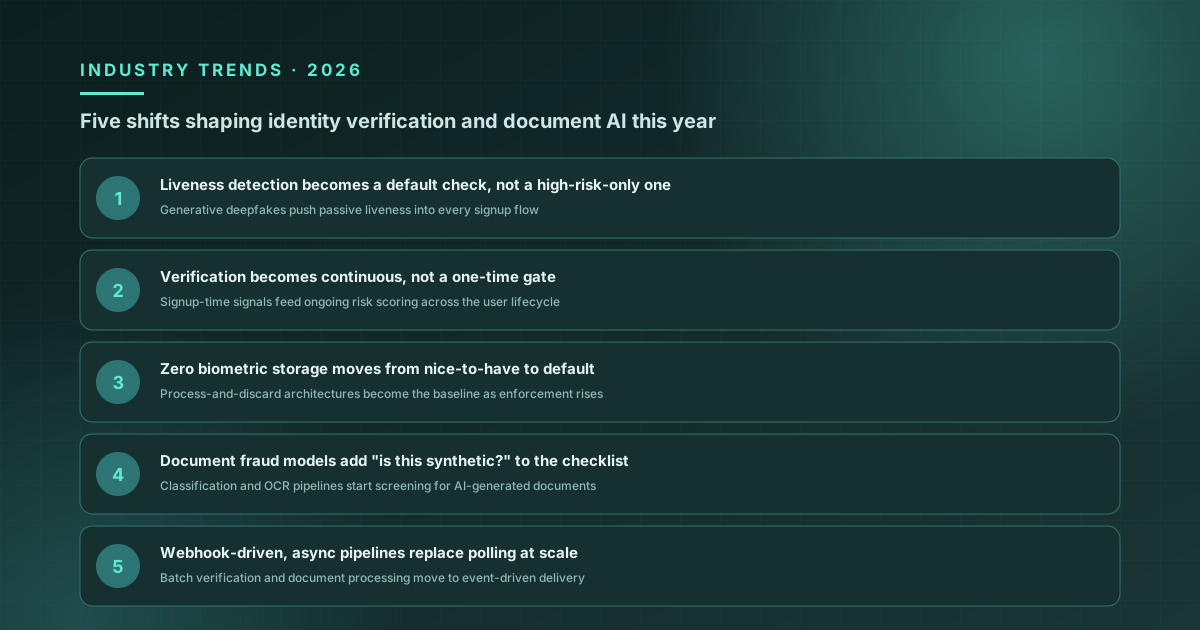
Every year brings incremental change to identity verification and document processing — better models, slightly tighter regulations, a new fraud pattern that gets folded into existing checks. 2026 feels different. The widespread availability of generative AI has changed what fraudsters can produce convincingly, biometric privacy enforcement has moved from "emerging risk" to "active litigation," and the architectural patterns for building verification into a product have matured enough that there are now clear right answers where a few years ago there were only trade-offs.
This post walks through five shifts we're seeing across the products we build and the integrations our customers run — what's changing, why, and what it means for teams building or maintaining verification flows this year.
1. Liveness detection becomes a default check, not a high-risk-only one
For years, the typical pattern was: run face similarity or face recognition for most signups, and reserve liveness detection — confirming that the face presented is a live person, not a photo, video replay, or mask — for "high-risk" flows like financial account opening or age-restricted services. Liveness checks added latency and friction, so teams rationed them.
That rationing model is breaking down for one reason: generative AI has made convincing spoofs cheap and accessible to anyone, not just sophisticated fraud rings. A still photo held up to a camera was always a weak attack — easy to detect with basic checks. A realistic synthetic video, generated in minutes from a single source image, is a fundamentally different threat, and it doesn't respect the boundary between "high-risk" and "low-risk" signups. A low-risk free-tier signup that gets used to build a fraud gallery, or to launder a stolen identity through a low-friction product before pivoting to a higher-value one, is exactly the kind of attack that "liveness only on high-risk flows" misses by design.
The practical shift: liveness detection is moving from an optional add-on to a default component of any flow that captures a face, the same way email verification became a default rather than something reserved for "important" accounts. The latency and UX cost of a passive liveness check — one that runs on a single frame or short capture without requiring the user to perform an action — has also dropped enough that the friction argument for skipping it doesn't hold up the way it used to. If you're running face similarity or face recognition checks at signup without a liveness check in front of them, that gap is now one of the more exploitable parts of a verification flow, not a minor one.
2. Verification becomes continuous, not a one-time gate
The traditional model treats identity verification as a gate: pass it once at signup, and the user is "verified" from then on. That model assumes the risk profile of an account is fixed at creation time — but accounts get compromised, credentials get sold, and "verified" doesn't mean "still controlled by the same person" six months later.
What we're seeing instead is verification signals being treated as inputs to ongoing risk scoring rather than a one-time pass/fail decision. The same checks that ran at signup — liveness scores, face similarity scores, duplicate-search results against a fraud gallery — get re-run or re-evaluated at other trust-sensitive moments: a password reset, a high-value transaction, a change to payout details. None of these moments need the full friction of the original onboarding flow, but they can reuse the same underlying checks at a lighter weight.
This shift is closely related to the layered approach described in our post on combining liveness, similarity, and recognition checks — the same four signals (liveness, similarity, duplicate search, face detection) that combine into an onboarding decision can be selectively re-applied at other points in the account lifecycle, with thresholds tuned to the specific moment rather than a single "verified at signup" threshold applied everywhere. The architectural implication is that verification logic shouldn't be hardcoded into a single "onboarding" code path — it should be a reusable service that other parts of the product can call when the risk calculus changes.
3. Zero biometric storage moves from nice-to-have to default
Biometric privacy law has gone from a niche compliance topic to one with real, recurring financial consequences. Illinois's BIPA continues to generate large class-action settlements, and the broader trend across US state privacy laws — and GDPR enforcement in the EU — has been toward classifying biometric data as sensitive by default and requiring proactive consent and minimization, not just a privacy policy disclosure.
The architectural response to this has been building for a few years, but 2026 is the year it stops being a differentiator and becomes the expected baseline: process biometric data for the duration of the request, and don't retain it afterward unless there's a specific, justified reason to. "We don't store your face" used to be a marketing point for privacy-conscious products. Increasingly, "why are you storing faces at all" is the default question a security review or legal team asks of any system that touches biometric data — and "we don't, here's the architecture diagram" is a much easier conversation than "we do, here's our retention policy and deletion pipeline."
This connects directly to the unified compliance posture we covered in our GDPR/BIPA/CCPA comparison: opt-in consent before capture, enforced retention limits, and minimization all become simpler — in some cases unnecessary — when the underlying architecture doesn't retain the data in the first place. For new integrations being designed in 2026, "do we need to store this image after the check completes" is worth asking explicitly during design, rather than defaulting to "store everything, decide on retention later" and retrofitting deletion logic afterward.
4. Document fraud models add "is this synthetic?" to the checklist
Document verification — extracting fields via OCR, classifying document types, checking that an ID matches a selfie — has historically focused on detecting altered documents: a changed date of birth, a swapped photo, a forged signature. The threat model assumed the attacker started with a real document and modified it, leaving traces (font mismatches, alignment artifacts, inconsistent metadata) that detection models could learn to spot.
Generative AI changes the starting point. Instead of altering a real document, an attacker can generate a synthetic one from scratch — a passport, a utility bill, a bank statement — that's internally consistent because nothing was "changed," it was generated as a whole. Detection approaches built around finding inconsistencies introduced by editing don't transfer cleanly to documents that were never edited because they were never real.
The response taking shape across the industry is to treat "is this document synthetic?" as its own check, separate from "does this document's content make sense?" and "what type of document is this?" — three different questions that historically got conflated into a single classification step. A document classification pipeline that confidently labels a document as bank_statement with 94% confidence has told you what kind of document it's looking at; it hasn't told you whether that bank statement was issued by a bank or generated by a model. As covered in our post on classification and routing pipelines, the practical pattern is to route documents by type and by a separate authenticity signal — a document that's confidently classified but fails an authenticity check should route to manual review, not straight through to the same pipeline as a verified-genuine document of the same type.
5. Webhook-driven, async pipelines replace polling at scale
The last shift is more architectural than threat-driven, but it's reshaping how verification gets integrated. As verification volume grows — from one-off signup checks to batch processing of documents, periodic re-verification, and bulk fraud-gallery searches — synchronous, request-per-item integration patterns stop scaling cleanly. A nightly job that needs to OCR a few thousand documents one at a time, waiting for each response before starting the next, spends most of its time waiting rather than processing.
The pattern that's replacing it: submit work in batches, get an immediate acknowledgment with a job identifier, and receive results asynchronously — either via a webhook callback when the job completes, or by polling a job status endpoint as a fallback. We covered this lifecycle in detail in our post on reliable async processing with webhooks, including the parts that are easy to get wrong: verifying webhook signatures correctly, and writing handlers that are safe under at-least-once delivery and retries.
What's notable about this shift is that it's not really new technology — webhooks and job queues are old patterns. What's new is that verification workloads have grown enough in volume that the operational cost of not using them — rate limit pressure from synchronous batch loops, idle time waiting on responses, complexity from custom polling loops built ad hoc per integration — has crossed the threshold where building proper async handling pays for itself. Teams integrating verification at scale in 2026 are building the webhook handler and idempotency layer once, early, rather than retrofitting it after a synchronous integration starts hitting rate limits under growth.
What this means for teams building verification flows now
These five shifts point in a consistent direction: verification is becoming more continuous, more privacy-conscious by default, more skeptical of synthetic content specifically (not just altered content), and more architecturally async. None of them require a wholesale rebuild of an existing integration — but they're useful as a checklist when reviewing or extending one:
- Is liveness detection part of every flow that captures a face, or only the ones flagged "high-risk" at design time?
- Are verification signals reusable as inputs to risk decisions beyond the initial signup gate?
- Does your architecture retain biometric images longer than the request that processed them — and if so, is that retention deliberate and governed, or just the default?
- Does your document pipeline check document type and authenticity as separate signals, or assume a confident classification implies a genuine document?
- For any workload processing more than a handful of items, is the integration async with proper webhook handling, or a synchronous loop that happens to still be under the rate limit — for now?
None of these are hypothetical concerns for 2027 — they're the questions worth asking about systems being built or extended this year.
Frequently asked questions
Do these trends apply to smaller products, or only large-scale platforms? The underlying drivers — generative AI lowering the cost of convincing spoofs and synthetic documents, and biometric privacy enforcement applying regardless of company size — affect products of any size. The architectural responses (default liveness, zero-storage processing, async pipelines) are also generally simpler to adopt early, before a large existing integration needs to be migrated, so smaller products are often better positioned to build them in from the start.
Is liveness detection noticeably slower or more intrusive for users than similarity checks alone? Passive liveness checks — analyzing a single capture without requiring the user to blink, turn their head, or follow prompts — add minimal latency and no extra user action in most implementations. The friction historically associated with liveness detection came from active, challenge-based approaches, which are still used for the highest-risk flows but are no longer the only option for a default check.
How does "zero biometric storage" work if we need to investigate a fraud case after the fact? Zero storage of raw images doesn't mean zero record-keeping — audit logs (what check ran, what score it returned, when, under what consent) can be retained without retaining the underlying image. For fraud investigation specifically, the decision and the signals that fed it are usually what's needed; the original image is rarely required once a decision has been made and logged.
If we're not at the volume where async processing matters yet, should we build it anyway?
If your current volume is comfortably synchronous, there's no need to add async infrastructure preemptively — but it's worth knowing where the threshold is for your rate limit tier, so the migration to async happens as a planned change rather than a reactive one when synchronous calls start returning 429s under growth.
Conclusion
2026's shifts in identity verification aren't about a single new technology — they're about threat models and architectures catching up to changes that have already happened. Generative AI has already changed what a convincing spoof or synthetic document looks like; biometric privacy enforcement has already moved from theoretical to costly; verification volume has already grown past what synchronous integration patterns handle gracefully. The teams best positioned this year are the ones treating these as design defaults for new work, not as a backlog of changes to existing systems.