Check a passport photo before you submit it
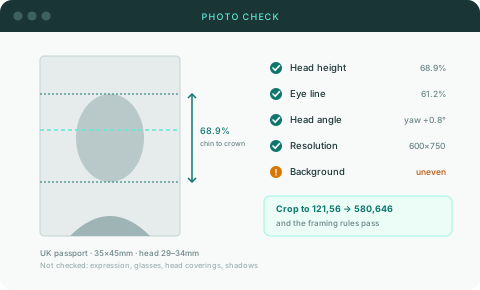
Checks a head-and-shoulders photo against one authority's published photo requirements and reports each measurement against the figure it has to meet. In beta: the standards covered are the US passport, the US visa and the UK passport.
- Head height, eye line, centring and head angle, against the published figures
- The crop that would satisfy the standard — or why no crop will
- Every requirement it does not check, returned with the result
Free plan included — no card needed to try it.
Try it here
Upload a head-and-shoulders photo and pick the standard to measure it against.
No account needed — 3 free runs every 2 days.
Photo
Drop a head-and-shoulders photo of one person
or click to browse · JPEG, PNG, WebP · max 25MB
Result
Upload a photo to measure it against the standard
Common questions
Will this tell me if my passport photo will be accepted?
No, and no tool honestly can. It tells you whether the parts that are measurable are inside the published figures — head height, eye line, centring, head angle, resolution and shape — which is where most photos are rejected. It cannot see whether your expression is neutral, whether your glasses are catching the light, whether a shadow falls behind your head, or whether anything is in the background. Every result lists exactly what was not checked, next to the verdict rather than buried in a help page.
Which standards can it check against?
Three: the United States passport, the United States visa, and the United Kingdom passport. Each one carries the government page its numbers came from and the date someone last read it, and the result links to it. Three rather than thirty on purpose — a preset is a set of figures somebody has to have read off an official page, and a wrong one is worse than a missing one, because it fails a photo that would have been accepted and you have no way to tell.
What are the actual US and UK requirements?
A US passport photo is 2 × 2 inches with the head between 1 and 1 3/8 inches from the chin to the top of the head — between 50% and 69% of the image height — and a digital one must be at least 600 × 600 and no more than 1200 × 1200 pixels. A US visa photo adds a rule the passport page does not have: the eye line between 56% and 69% of the way up from the bottom edge. A UK passport photo is 35 × 45mm with the head between 29 and 34mm chin to crown — 64% to 76% of the height — and at least 600 × 750 pixels.
How is the head height measured if the top of my head is hair?
Both the UK and the US measure to the crown — the top of the skull — and explicitly not the top of the hair, which is why looking for the highest dark pixel in the image gives the wrong answer for anyone with volume in their hairstyle. The chin and the brow line come from 68 facial landmarks, and the crown is projected upward from the brows by a fixed proportion of the brow-to-jaw distance. It measures a head rather than a haircut.
Can I just crop my photo to fix it?
Often, and the result tells you. Every check comes back with the pixel rectangle that would satisfy the standard, and it searches the whole allowed range rather than one ideal framing — so a photo that cannot take the textbook crop usually still has one that works. When nothing fits, it says so and says what is missing, for example “needs 117px to the right that the photo does not have”. That is the answer worth having: crop it, or take it again.
Can I try it without an account?
Yes — 3 photos every two days, no sign-up, nothing to install. An account adds a one-time allowance of 20 operations on the free plan and keeps your runs so you can compare one attempt against the next, which is what you want when you are nudging a crop a few pixels at a time.
Why does it say my head is tilted when I am looking straight ahead?
It should not, and if it does it will be a warning rather than a failure. Head turn (yaw) and tilt (roll) are measured from the same 68 landmarks and sit reliably near zero on a photo shot square to the camera, so those can fail. Nodding (pitch) is different: measured across eleven frontal portraits it never once read near zero, because the figure carries a systematic offset from the reference shape it is fitted against. So pitch is reported with that offset removed and a deliberately wide tolerance, and it can only ever warn. Rejecting someone on a number we know is biased would be indefensible.
What can I upload, and does it work for more than one person?
JPEG, PNG or WebP, one person per photo — a passport or visa photo shows one subject alone, so two faces is refused rather than guessed at. If you also need to blur faces before publishing a photo, or to compare two faces, those are separate tools on the same account.