Passport Photo Head Size: The Measurements That Get Photos Rejected
The US wants your head between 50% and 69% of the frame. The UK wants 29mm to 34mm of a 45mm photo. Here is where those figures come from, how to measure your own, and which rules nobody publishes a number for.
Most passport photo advice is written in adjectives. Plain background. Neutral expression. Head centred. All true, all unmeasurable, and none of it tells you whether the photo on your phone right now is going to be accepted.
A handful of the rules are different. They are published as numbers, by the authority that will accept or reject the application, and you can check them yourself with any image editor. Those are the ones worth knowing, because they are the ones a reviewer can point at.
This is what those numbers are, where they come from, and how to measure your own photo against them.
The head size rule
This is the single most common reason a technically fine photograph gets rejected: the head is the wrong size in the frame. Not blurry, not badly lit — the right picture, cropped wrong.
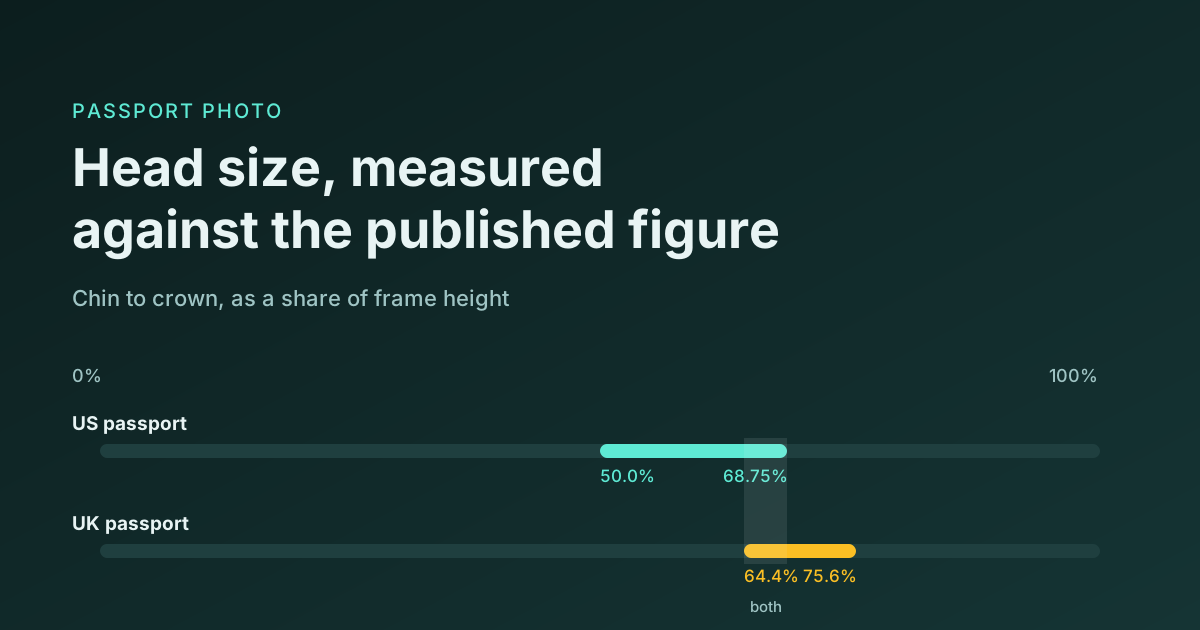
United States. The State Department specifies head height between 1 inch and 1 3/8 inches in a 2 inch by 2 inch photo. As a fraction of frame height that is 50% to 68.75%. The photo must be square, and digitally it must be at least 600 × 600 pixels and no more than 1200 × 1200.
United Kingdom. GOV.UK specifies 29mm to 34mm from chin to crown in a 35mm × 45mm photo — 64.4% to 75.6% of frame height. Digitally, at least 600 × 750 pixels.
Two things follow from putting those side by side.
The ranges do not overlap neatly. A photo at 60% of frame height satisfies the US and misses the UK minimum. One at 72% satisfies the UK and exceeds the US maximum. There is a window around 64.4% to 68.75% that suits both, and outside it you cannot reuse one photo for the other country, however good it is.
And "head height" means chin to crown — the top of the skull, not the top of the hair. Voluminous hair does not make your head taller for this purpose, which is a real source of over-cropping. If you have measured from the top of a hairstyle, you have measured the wrong thing and your head will come out smaller than you calculated.
The eye line rule, which only one of them publishes
US visa photos carry a rule the US passport does not: the eyes must sit between 56% and 69% of the way up from the bottom of the image. The passport standard specifies head height and says nothing about eye position.
If you are preparing a visa photo and have only ever read the passport guidance, this is the rule you have not seen. It is also the one most likely to catch a photo where the subject was framed slightly low in an otherwise correct crop.
How to measure your own photo
You need two numbers: the image height, and the chin-to-crown distance in pixels.
- Open the photo in any editor that shows pixel coordinates.
- Note the pixel row of the bottom of the chin.
- Note the pixel row of the top of the skull — estimate it under the hair rather than at the top of it.
- Subtract to get head height in pixels, then divide by the total image height.
A 900-pixel-tall photo with 580 pixels from chin to crown gives 0.644, or 64.4% — the UK minimum exactly, and comfortably inside the US range.
The crown estimate is the awkward step, and it is awkward for automated tools too. The crown is not a visible landmark: face-detection models find eyes, nose, mouth and jaw reliably, and the top of the skull is inferred from them. Any tool that reports your head height, ours included, is estimating that point rather than measuring it. A centimetre of disagreement at the crown is roughly two percentage points of head height, which matters when you are near the edge of a range.
The rules nobody gives you a number for
Here is where the published figures stop, and it is worth being clear about it because most "photo checkers" are not.
Both authorities require a plain, light background. Neither publishes a brightness value, a colour, or a tolerance for how uneven it may be. Both require the photo to be sharp and well lit. Neither publishes a sharpness metric or an exposure range. Both require a neutral expression with the mouth closed, both eyes open and visible, no head covering except for religious or medical reasons, and no shadows across the face or behind the head.
None of those have a number attached. A tool that tells you your background "passes" is applying a threshold somebody at that company chose. It may be a sensible threshold. It is not the government's, because the government did not publish one.
This is the distinction worth carrying into any checker you use: a rule with a published figure can be measured, and a rule without one can only be judged. Both matter for acceptance. Only the first can be checked by software without inventing something.
Why photos actually get rejected
Ranked roughly by how often each one is the real cause:
- Head size outside the range — almost always too large, from cropping tight to make the face prominent.
- Crown measured at the hair — the same error, in a different direction, usually making the head too small.
- Shadow behind the head — a plain wall still casts one if the subject stands close to it. Standing a step forward removes it.
- Resolution below the digital minimum — a photo cropped from a group shot is often under 600 pixels on the short side once the crop is applied.
- Wrong aspect ratio — 4:5 is not 35:45. A 600 × 750 photo is 0.800; the UK ratio is 0.778. They are close enough to look right and different enough to matter.
- Expression — a slight smile is a rejection, and it is the rule people most often think they can get away with.
Numbers 1, 2, 4 and 5 are measurable before you submit. The rest are not, which is why no honest tool will promise you an acceptance.
Checking a photo automatically
Photo Check measures a portrait against one authority's published figures and reports each measurement against the figure it has to meet, along with the source page and the date that page was read. It returns the crop that would satisfy the standard, or tells you that no crop of this image will and the photo has to be taken again.
It also returns, on every response, the list of requirements it did not check — expression, eyes open, glasses, head coverings, shadows, background objects, red-eye, print quality, recency, and whether you still look like the photograph. That list is part of the answer rather than buried in documentation, because a tool that reports a pass without it has implied something it cannot support.
Three free checks, no account needed.
Frequently asked questions
How much of a passport photo should the head take up? For a US passport, between 50% and 68.75% of the image height, chin to crown. For a UK passport, between 64.4% and 75.6%. Both are published by the issuing authority and both are measured to the crown of the skull rather than the top of the hair.
Can I use the same photo for a US and a UK passport? Only if the head height falls in the overlap, roughly 64.4% to 68.75% of frame height, and only if you also re-crop to the right shape — the US wants a square, the UK wants 35:45. The aspect ratios are not compatible, so the same file will not do for both even when the head size works.
Why does my photo fail when it looks correct? Most often the head is slightly too large, or the crown was measured at the hairline. Both are invisible by eye and obvious once measured. The next most common is a shadow behind the head, which a plain background does not prevent.
Will a photo checker guarantee my application is accepted? No, and be wary of any that implies it. The measurable rules are a minority of the published requirements. Expression, eye visibility, head coverings and shadows all carry rules with no number attached, and a reviewer applies judgement to those.
Do these figures change? They do, occasionally, and usually without announcement. Any figure quoted here or anywhere else is worth checking against the authority's own page before you rely on it — which is why ours are returned with the source URL and the date that page was last read.